


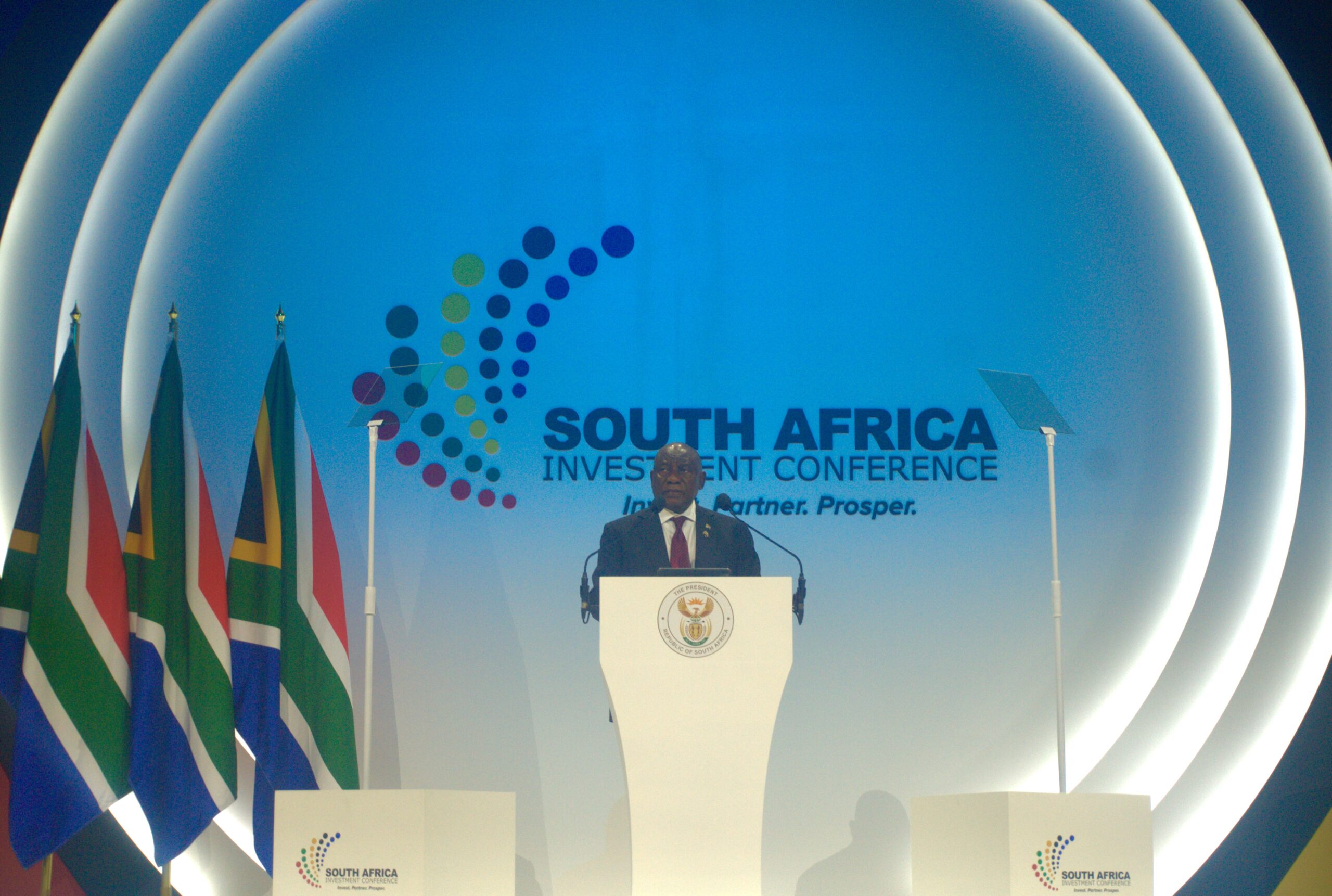

At the 6th edition of the South African Investment Conference, held in Johannesburg, President Cyril Ramaphosa delivered a wide-ranging address outlining South Africa’s economic trajectory, reform agenda, and long-term investment potential. The conference, which forms part of the country’s broader investment mobilisation drive, brought together more than 1,200 delegates from over 50 countries, all engaging with South Africa’s evolving economic story.
A narrative of resilience and reinvention
President Ramaphosa positioned South Africa as a country shaped by both historical struggle and democratic transformation, describing the post-1994 era as one defined by freedom, opportunity, and ongoing structural change. He reflected on the country’s journey since the advent of democracy, noting that while significant progress has been made, the core task remains to ensure that economic growth is inclusive and benefits the majority of citizens.
He emphasised that South Africa is now one of Africa’s most industrialised, diverse, and open economies, with a dynamic private sector and strong institutional foundations. Despite global shocks including geopolitical tensions, the COVID-19 pandemic, energy instability, and years of weak growth, the economy has maintained stability and continues to demonstrate resilience.

Investment momentum and global confidence
A key message of the President’s address was that South Africa remains an “investable” and credible destination for long-term capital. He highlighted that between 2018 and 2023, the country attracted approximately R1.5 trillion in investment commitments across sectors, including energy, telecommunications, infrastructure, mining, and manufacturing.
He further noted growing international confidence in South Africa’s economic direction, citing participation from investors across continents and continued interest in the country’s infrastructure, energy transition, and industrial development agenda.
According to the President, recent macroeconomic indicators point to a gradual strengthening of the economy. These include consecutive quarters of growth, stable inflation trending toward the 3% target range, improved sovereign outlooks, and South Africa’s removal from the Financial Action Task Force (FATF) grey list.
Structural reforms and the “3Ds” framework
Central to the address was the government’s structural reform programme, anchored in what he described as the “3Ds” framework: decarbonisation, digitisation, and diversification.
Ramaphosa stressed that these priorities are shaping South Africa’s investment strategy and positioning the country for future global competitiveness. He noted that investors increasingly prioritise execution, policy certainty, and regulatory efficiency rather than commitments alone.
A major institutional reform highlighted was “Operation Vulindlela,” a joint initiative between the Presidency and National Treasury aimed at accelerating structural reforms, reducing red tape, and improving the ease of doing business.
The President also pointed to reforms in visa systems, describing them as a response to investor concerns about delays in bringing in skilled personnel. New measures include streamlined visa pathways, trusted employer schemes, and a points-based system designed to facilitate the movement of talent and investment.
Energy reform and the transition to a low-carbon economy
One of the most significant areas of progress highlighted was the transformation of South Africa’s energy sector. Ramaphosa detailed ongoing reforms in electricity generation and transmission, including the restructuring of the national power utility, the establishment of an independent transmission system operator, and the opening of the energy market to private participation.
He noted that the government’s Energy Action Plan has helped stabilise electricity supply and reduce disruptions, creating a more reliable environment for business investment.
South Africa, he said, is now seeing a major pipeline of renewable energy development, with over 220 gigawatts of projects in various stages of planning and tens of gigawatts already in grid connection processes. This transition is expected to drive investment in solar, wind, battery storage, and electric vehicle manufacturing.
The President also emphasised South Africa’s strategic advantage in critical minerals, including platinum group metals and manganese, positioning the country as a key player in the global clean energy transition.
Infrastructure as the engine of growth
A major theme of the address was the scale of planned infrastructure investment. Ramaphosa announced that over the next three years, South Africa plans to invest more than R3 trillion in public infrastructure.
This includes major allocations across transport, energy, water, and logistics systems:
- Expansion and modernisation of ports and rail networks
- Significant upgrades to national roads
- Large-scale investment in passenger rail infrastructure
- Expansion of airports and freight logistics systems
- Water infrastructure projects, including dams, desalination, and cross-border water transfers
He highlighted flagship projects such as the expansion of the Square Kilometre Array (SKA) radio telescope, describing it as a symbol of South Africa’s scientific capability and global competitiveness in advanced research infrastructure.
Water security and municipal reform
The President also addressed South Africa’s water challenges, describing water infrastructure as a critical investment frontier. Government reforms include the establishment of professionally managed water utilities in metropolitan municipalities and a regulatory framework aimed at improving service delivery and reducing inefficiencies.
He further highlighted major projects such as Phase 2 of the Lesotho Highlands Water Project, which remains central to securing long-term water supply for Gauteng and surrounding regions.
Inclusive growth and transformation
Ramaphosa reaffirmed that South Africa’s growth model is rooted in inclusion and transformation. He defended policies aimed at broadening participation in the economy, including Broad-Based Black Economic Empowerment (B-BBEE) and equity equivalent investment programmes for multinational companies.
He argued that these frameworks are not barriers to investment but mechanisms designed to ensure that economic growth is widely shared, skills are transferred, and historically excluded groups participate meaningfully in the economy.
A forward-looking investment agenda
The President concluded by framing the conference as a transition point from economic recovery to expansion. He announced a renewed investment mobilisation target of R2 trillion over the next five years, signalling an intensified effort to attract domestic and foreign capital.
He also noted that new investment commitments announced at the conference amount to nearly R900 billion across multiple projects, provinces, and sectors, with the potential to create over 200,000 jobs.
Ramaphosa emphasised that South Africa’s reform agenda is “irreversible,” driven by the need to build a more inclusive, competitive, and globally integrated economy. He stressed that the government’s role is to enable investment, reduce barriers, and ensure that economic growth translates into tangible benefits for all citizens.
Conclusion
The 6th South African Investment Conference reaffirmed South Africa’s ambition to position itself as a leading investment destination in Africa and globally. With structural reforms underway, major infrastructure pipelines in motion, and a clear focus on energy transition and industrialisation, the country is seeking to convert investor confidence into measurable economic transformation and job creation.
As Ramaphosa concluded, the future of South Africa’s economy will depend not only on commitments made at conferences, but on the sustained execution of reforms that unlock long-term growth and shared prosperity.

