


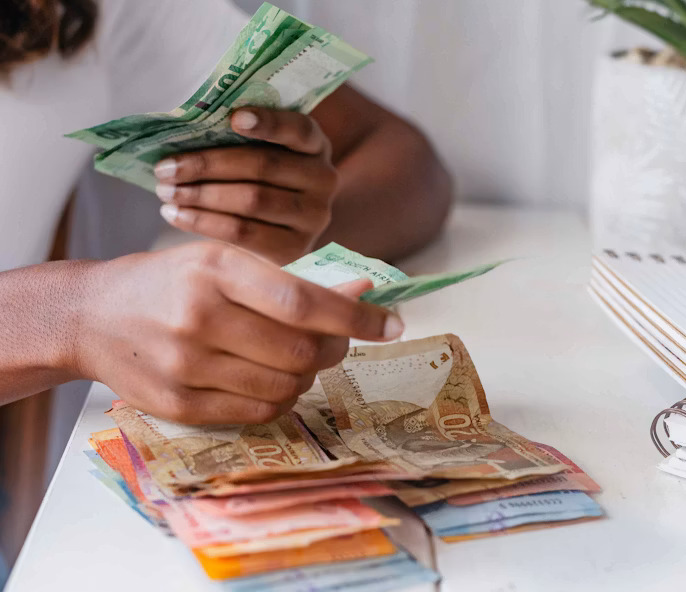

For many working South Africans, payday brings only temporary relief.
Within days of receiving a salary, money has already been allocated to rent or bond repayments, electricity, groceries, transport, insurance, school expenses, and debt repayments. By the middle of the month, many households are already counting down the days until their next pay cheque.
This is despite the latest data showing that the average South African now takes home R21,228 per month.
At first glance, that figure appears relatively healthy. It places many workers above South Africa’s minimum wage and suggests that employed South Africans should have enough income to live comfortably. However, new analysis shows that the reality is very different.
According to the latest PayInc Net Salary Index, the average monthly take-home salary in South Africa stands at approximately R21,228, but rising living costs and shrinking purchasing power mean that this income simply does not stretch as far as many people think.
The biggest reason is simple: most of that salary is already spoken for before the month has properly begun.
Using household expenditure patterns from Statistics South Africa, financial analysts calculated how an average monthly salary is typically spent. The findings reveal that the largest portion of income disappears into essential expenses that cannot easily be avoided.
Housing remains the single biggest expense for South African households. On an average monthly income of R21,228, around 34.7%, or approximately R7,366, goes towards accommodation, municipal rates, electricity, water, and other household utilities.
Food is the second-largest expense. Approximately 16.3% of monthly income, about R3,460, is spent on groceries and non-alcoholic beverages. With food inflation remaining stubbornly high over recent years, many households have had to adjust their shopping habits, buying fewer branded products, purchasing in bulk when specials are available, or cutting back on non-essential food items altogether.
Transport consumes another significant portion of income.
Whether commuting by taxi, bus, train, or private vehicle, South Africans spend roughly 15.3% of their salary on transport. For someone earning R21,228, that works out to around R3,248 every month. Fuel prices, vehicle maintenance, insurance and public transport fares continue to place pressure on household budgets, particularly for workers travelling long distances to reach employment opportunities.
Insurance and financial services account for another 9.4%, or approximately R1,995, each month. This category includes short-term insurance, funeral cover, banking costs, and other financial products that many households rely on for financial protection.
Together, these four categories alone consume approximately R16,070 every month.
That leaves only around R5,158.
While R5,158 may initially sound manageable, it still has to cover virtually every other aspect of daily life.
This includes clothing, healthcare costs not covered by medical aid, cellphone contracts, internet services, education expenses, household goods, entertainment, toiletries, children’s needs, vehicle repairs, gifts, emergency savings, and any unexpected financial shocks.
For millions of South Africans, this remaining amount disappears quickly.
A single unexpected expense, a burst geyser, replacing worn tyres, emergency medical treatment, funeral contributions, appliance repairs, or even replacing a stolen cellphone, can wipe out what little disposable income remains.
This explains why many households earning what appears to be an average salary still find themselves relying on credit cards, overdrafts, personal loans, or retail credit before the end of the month.
Financial experts say this “one unexpected expense” has become the tipping point that pushes many consumers into debt.
The situation is made worse by inflation.
Although salaries have increased modestly over the past year, inflation has reduced what those salaries can actually buy.
The PayInc Net Salary Index shows that while the average nominal net salary increased to around R21,510 during May 2026, real take-home pay, which adjusts income for inflation, fell to approximately R20,262.
In practical terms, South Africans may be receiving more money than they were last year, but that money buys fewer groceries, less fuel and fewer everyday essentials.
Economists describe this as declining purchasing power.
It means salary increases are effectively being cancelled out by higher prices across the economy.
Electricity tariffs have continued to rise, municipal charges have increased in many cities, medical aid premiums have become more expensive, school costs continue climbing, and everyday grocery prices remain under pressure.
For households already operating on tight budgets, even relatively small increases across several expenses quickly add up.
This is one of the reasons debt counsellors say they are seeing more middle-income South Africans seeking financial assistance.
Contrary to popular belief, debt stress is no longer limited to low-income households.
Workers earning above R20,000 per month are increasingly struggling to meet monthly financial commitments because so much of their income is already committed to fixed expenses.
Many consumers are finding themselves using credit simply to cover everyday necessities rather than luxury purchases.
Once debt repayments begin consuming more of a monthly salary, households have even less flexibility to absorb unexpected expenses, creating a cycle that becomes increasingly difficult to escape.
The findings also challenge perceptions about South Africa’s middle class.
Research referenced in the analysis suggests that middle-class household income generally ranges between R22,000 and R75,000 per month.
Ironically, the country’s average take-home salary falls just below the lower end of that range.
This means many people who consider themselves middle class may actually be earning less than what researchers classify as the minimum income required for that group.
The average salary figure itself also needs to be understood carefully.
An average does not mean that most South Africans earn R21,228.
Higher-income earners increase the national average, while millions of workers earn substantially less.
South Africa continues to have one of the world’s highest levels of income inequality, meaning average salary figures can sometimes create the impression that workers are earning more than many actually do.
For households earning below the national average, the financial pressure is even greater.
Essential expenses such as rent, groceries, and transport still need to be paid regardless of income level, meaning lower-income households often spend an even larger percentage of their salary on necessities.
This leaves very little room for savings or investments.
The latest data also highlights a broader shift in consumer behaviour across South Africa.
Households are becoming increasingly careful about how they spend money.
Consumers are comparing supermarket prices more frequently, delaying major purchases, taking advantage of retailer promotions, using loyalty programmes, and searching for cheaper alternatives across almost every category of spending.
Discretionary purchases such as eating out, entertainment, holidays, and luxury goods are often the first expenses to be reduced when household budgets come under pressure.
Financial planners continue to encourage South Africans to build emergency savings wherever possible, reduce unnecessary debt, and regularly review monthly budgets.
However, many households argue that budgeting alone cannot overcome the reality that essential living costs are increasing faster than incomes.
For families across Johannesburg, Pretoria, Ekurhuleni, Tshwane, Cape Town, Durban, Gqeberha, Bloemfontein, Polokwane, Mbombela, Kimberley and other parts of South Africa, this has become an everyday reality.
The latest figures show that earning the average South African salary no longer guarantees financial security.
Instead, it highlights how quickly essential expenses consume household income, leaving little room for savings or financial resilience.
Until wage growth consistently exceeds inflation and the cost of living begins to stabilise, millions of South Africans are likely to continue experiencing the same monthly cycle, receiving a salary that looks reasonable on paper but disappears long before the next payday arrives.

